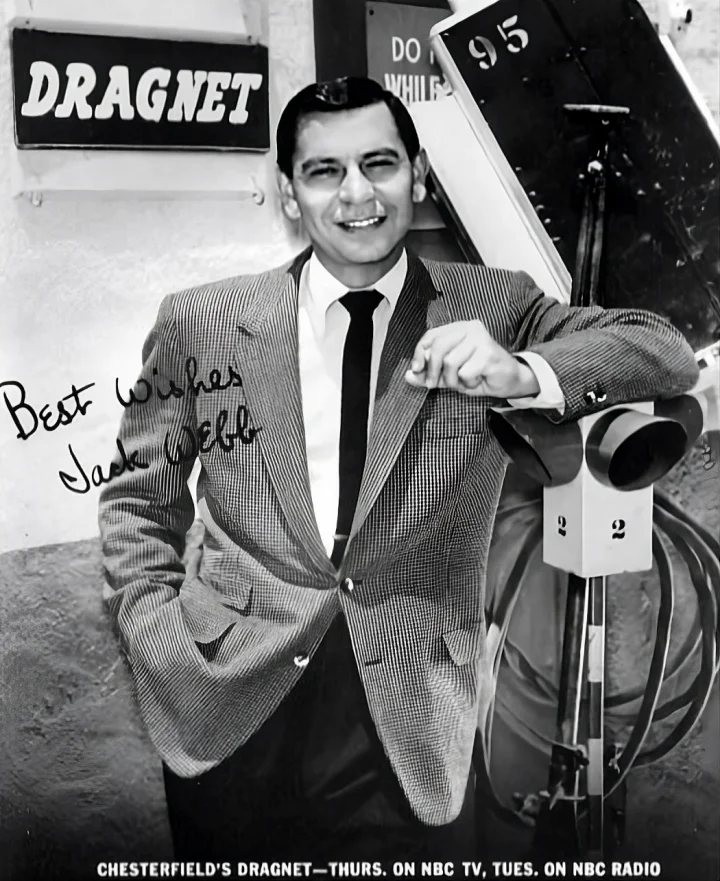
Dragnet
How a Cop Shop Became a Concept
Dragnet didn't start with a pitch meeting. It started with a movie prop. When Jack Webb took a small role in the 1948 film He Walked by Night, he played a crime lab cop — a bit part, nothing special on paper. But the technical adviser on that picture was Sergeant Marty Wynn of the Los Angeles Police, and somewhere between setups, Webb and Wynn landed on a shared conviction that pure investigative procedure was dramatic enough on its own. No wisecracking private eye. No manufactured melodrama. Just the actual, methodical work of detectives solving real crimes. That conversation eventually became the most imitated police drama in American broadcast history.
Webb had been kicking around radio since 1945, when he arrived at KGO, the ABC outlet in San Francisco, as an unknown staff announcer doing disc jockey work and a morning show called The Coffee Club. He played a waterfront detective for 26 weeks in Pat Novak, For Hire, a series so aggressively hard-boiled it tipped into camp. Mutual put him in a sound-alike called Johnny Modero: Pier 23 the following summer. He turned up in supporting parts on Escape, The Whistler, and This Is Your FBI. None of it was what he wanted to make. The Wynn conversation pointed toward something different — a show grounded in the actual rhythms and language of police work, not the theatrical rhythms of the genre.
Webb spent more than a year developing the concept. He hung out at LAPD headquarters, rode with detective teams, attended classes at the police academy, and made himself fluent in the terminology and technique of real police procedure. He was building a vocabulary, not just a show. When he finally brought the proposal to NBC, the network was unimpressed and told him to prepare an audition record in one week. Webb took that audition record with writer James E. Moser to meet C. B. Horrall, the chief of police in Los Angeles. Horrall listened to ten minutes of it, stood up, and left the room without saying a word. Despite that inauspicious reception, the LAPD approved the partnership — with conditions. The police required control over the show's sponsorship, assurance that confidential files would be protected, and a guarantee that the department would never be scripted into unflattering situations. Within those boundaries, Webb had access to real case files and real procedural detail that no other radio show had ever enjoyed.
A Show That Almost Didn't Last
Dragnet premiered on NBC on June 3, 1949 as a summer replacement for The Life of Riley. It nearly didn't survive its first season. The earliest episodes mimicked the strident Gang Busters opening, with an announcer shouting "Draaaaag...net!" — a holdover from the genre it was trying to escape. Webb killed that within a few weeks and adopted the deadpan delivery the show became known for. For eighteen weeks Dragnet ran without a sponsor. The show was on a month-to-month option, cancellable on a week's notice, and NBC's East Coast executives were pressuring Webb to add gunplay and snappier dialogue.
What saved it was a column. On June 13, 1949, radio critic John Crosby praised Dragnet in the New York Herald-Tribune for showing authentic police work, and Webb credited that review for the rest of his life with rescuing the show. Crosby's column gave Webb enough leverage to fire the network-imposed writer Bob Ryf and bring in his KGO colleague James E. Moser, who wrote the opening and closing formats that became the show's signature. By November, Liggett & Myers had picked it up for Fatima Cigarettes. The first season Hooper rating was only an 8.5 — 64th place overall — but the show was alive, and it was now Webb's.
The Sound of the Thing
The famous four-note march theme — what Tim Brooks and Earle Marsh later described in their Complete Directory to Prime-Time Network TV Shows as "possibly the most famous four-note introduction since Beethoven's Fifth Symphony" — wasn't there at the premiere. It first appeared on the third broadcast, June 17, 1949, an episode called "The Werewolf," and it stayed. Walter Schumann got the credit, though the four-note motif had originated in Miklós Rózsa's score for the 1946 film The Killers, in a cue called "Danger Ahead." A copyright suit followed in 1953, and a 1955 settlement gave Rózsa and Schumann shared royalties on the "Main Title" while leaving the "Dragnet March" itself solely Schumann's. The bridge music Schumann wrote was, as Brooks and Marsh put it, "laced throughout every episode, dark and tension-filled, then erupting in a loud stinger after an especially significant revelation."
The opening ritual set the tone for everything that followed. Announcer Hal Gibney delivered the line everyone remembers: "Ladies and gentlemen... the story you are about to hear is true. Only the names have been changed to protect the innocent." But Gibney didn't do it alone — he and George Fenneman bounced lines back and forth in the opening sequence, an arrangement that gave the whole setup a kind of institutional weight, as if two officials were reading from a record. Gibney would often set the case up in second person — "You're a detective sergeant. You're assigned to auto theft detail..." — before formally introducing the program as "the documented drama of an actual crime."
The sound effects operation behind each episode was staggering in its specificity. When characters walked up steps at police headquarters, the sound effects crew used the exact number of steps between floors in the actual building. When Sergeant Joe Friday read a crime report on air, listeners heard him turn to the second page first — because descriptions were always on the second page of real LAPD reports. Each episode could call on as many as 300 sound effects, keeping five soundmen busy for the full 30 minutes. The work was handled by Wayne Kenworthy, Jack Robinson, Bud Tollefson, and others who became expert in what was essentially a documentary form of radio craft.
Webb was equally precise about performance. In a 1950 Time profile, he described his goal as making it "as real as a guy pouring a cup of coffee," and rejected the term "underplaying" as a label for what he was doing. The idea wasn't that Friday was flat — it was that Friday was real, and real policemen don't emote for effect. He populated the show with real LAPD dispatcher codes that were never explained to the audience: 211 meant robbery, 484 meant theft, 459 meant burglary, 390 meant a drunk, 415 meant disturbing the peace, 311 meant lewd conduct. The show used real penal-code section numbers and real abbreviations — APB, DMV, R&I, MO, the I-sheet for suspect descriptions, the LAPD's actual radio call sign KMA367. Listeners learned the vocabulary the way a new officer would, by immersion. Friday's badge number, 714, Webb picked for "luck and double luck" — and, as he told it, because Babe Ruth had hit 714 home runs.
Joe Friday and His Partners
Jack Webb played Detective Sergeant Joe Friday, a bachelor who lived with his mother — a detail that quietly grounded the character in something ordinary and unromantic. Peggy Webber played Ma Friday, a feat of vocal performance that says something about radio: Webber was a young woman who could convincingly portray an elderly one without anyone being the wiser. Webb, famously, never let Webber rehearse her scenes with the rest of the cast. He believed she gave a better performance reading cold, and he was the kind of director who acted on beliefs like that.
Barton Yarborough played Sergeant Ben Romero, Friday's first partner. Yarborough had been playing Clifford Barbour on One Man's Family since 1932 and continued in that role concurrently with Dragnet. The two had a working chemistry, and Webb had plans to carry Yarborough into the television version of the show. When someone questioned whether Yarborough would "look right" on TV, Webb told Radio Life: "I'll take the actor and he'll look right." One TV episode was shot with Yarborough as Romero — a pre-series special aired on NBC's Chesterfield Sound-Off Time on December 16, 1951. Three days later, on December 19, Yarborough died of a cerebral embolism at his home in Burbank. He'd appeared in 132 episodes of Dragnet, with a 133rd recorded a week before his death.
Webb's response was extraordinary. Eight days after Yarborough died, on December 27, 1951, Dragnet broadcast an episode titled "The Big Sorrow" in which Ben Romero died of a heart attack. The episode ends with Joe Friday mistakenly calling his new partner "Ben." It was a public act of mourning embedded in the fiction. The role of partner then went through a parade of actors — Barney Phillips as a new character named Ed Jacobs, then Harry Bartell, Herb Ellis, Vic Perrin, and Ken Patterson all taking turns at a character called Frank Smith, plus a brief run by Martin Milner as Romero's nephew Officer Bill Lockwood in the spring of 1952 — before Ben Alexander settled the position for good starting in October 1952. Comedy actor Cliff Arquette had worked with Alexander on a Dragnet TV episode and recommended him to Webb.
Smith was deliberately drawn as a contrast to Friday — paunchy, perpetually worried, prone to disputes with his wife Fay and fussy about his pills and his exotic recipes, forever complaining about his brother-in-law Armand. Where Friday was composed and precise, Smith was anxious and domestic. The pairing gave the show texture it hadn't had before. When Smith was wounded in a two-part story, thousands of listeners wrote in. That kind of audience investment doesn't happen for a prop.
Raymond Bunas played Ed Backstrand, chief of detectives. Herb Butterfield appeared as Lt. Lee Jones of the crime lab — using the real name of an actual LAPD officer, as the show often did. The supporting cast drew from a wide pool of Hollywood radio talent: Sam Edwards, Parley Baer, Vic Perrin, Stacy Harris, Georgia Ellis, Virginia Gregg — performers who could step into any character the case required.
What It Would and Wouldn't Do
Webb was explicit with the Time profile about the show's ethical stance, and it wasn't the conventional one: "We don't even try to prove that crime doesn't pay. Sometimes it does." That was a sharp departure from the moralistic bookkeeping most crime drama performed, and it gave Dragnet an uncommon credibility. Cases didn't resolve tidily because cases don't.
The show also pushed into territory other programs treated as off-limits. Dragnet was among the first radio dramas to break the taboo against depicting sex crimes. It was among the first to dramatize the killing of children. The holiday episode known as "A Gun for Christmas" showed a child — Stevie Morheim — killed with a gift gun, and included an exchange that became one of the show's most remembered moments. Romero asks, "What's it all prove, Joe?" and Friday replies: "You don't give a kid a gun for Christmas." The episode generated a flood of protest mail. Webb passed the letters to Chief William H. Parker, who had by then succeeded Horrall and whose name became most closely associated with the show's technical standards. The police, in response, promised organizations including the National Rifle Association ten more shows illustrating the consequences of giving rifles to children. On other particularly brutal stories, Fenneman would deliver a pre-broadcast note: "this story is for you, not your children."
Narcotics cases were a recurring subject, depicted as a destructive social force rather than a thrill. Bunco, robbery, murder, sex offenses — the show worked across the full spectrum of what an LAPD detective actually saw. Episodes like "The Big Trio" (July 3, 1952) packed three separate cases into one broadcast, including fatal reckless driving by unlicensed juveniles. The show's downtown Los Angeles — cheap bars and cafes, residential hotels, working-class boarding houses — became, in retrospect, an audio document of a city about to be remade by urban renewal. The journal The Commonweal praised Dragnet for featuring "no stereotyped hoodlums," calling it an intelligent program. The criminals were not central-casting thugs but ordinary people in particular circumstances, which made the cases feel like case files rather than fiction.
The Parody That Became the Catchphrase
By 1953 Dragnet had become culturally inescapable, and that's when Stan Freberg got hold of it. Working with Daws Butler and featuring June Foray and Hy Averback, Freberg recorded an audio parody called "St. George and the Dragonet" on August 26, 1953 and released it on Capitol Records the following month. It hit #1 on both Billboard and Cash Box and sold over a million copies in three weeks. Webb was so delighted he allowed the actual Dragnet theme music to be used on the record. Freberg followed it with a Christmas parody called "Yulenet," and by March 1954, a Time cover profile of Webb noted that the parody records had sold 1,326,000 copies between them.
The parody had a side effect that outlasted the show. Joe Friday never actually said "Just the facts, ma'am" — his real line was a variation of "All we want are the facts, ma'am." The phrase that everyone remembers came from Freberg's record, where he said, "I just want to get the facts, ma'am." It's a small thing, but it's a useful reminder of how cultural memory works: the version that sticks isn't always the one that aired. That same year Ray Anthony and his Orchestra released a recording of the Dragnet theme that reached #2 on Billboard and sold over 500,000 copies — one of the first TV themes to cross over into pop music.
The Schedule and the Run
Dragnet moved around the NBC schedule over its eight years. The first four months had no fixed time slot. From 1949 to 1950 it settled in on Thursday nights at 10:30 with Fatima Cigarettes as the sponsor. Fatima stayed on through the next year as the show moved to Thursday at 9:00, then Chesterfield took over the sponsorship and held it through several more schedule shifts — Thursdays at 9, then Sundays at 9:30, then Tuesdays at 9 and later 8:30. From 1955 to the final broadcast on February 26, 1957, the Tuesday 8:30 slot ran repeat broadcasts under multiple sponsorships. The final original radio episode, "The Big Close," aired September 20, 1955 — the 314th original broadcast and the last under Chesterfield. By May 1955 the radio audience was estimated at around three million listeners weekly, and the show's persistence on radio until 1957, well after most network drama had migrated to television, was partly a function of Webb's genuine affection for the medium that had made him.
Primary writing credit went to James E. Moser, with Jack Robinson also contributing scripts. Early direction came from Bill Rousseau; Webb eventually directed the show himself, which fit with the degree of control the production required to maintain its standard. Webb also created Pete Kelly's Blues on NBC in 1951 while Dragnet was running — a jazz-themed vehicle that reflected the musical interest he'd carried since his Coffee Club days in San Francisco, and that he'd carry the rest of his life through a personal collection of more than 6,000 jazz recordings.
After the Broadcast
The radio show ended in 1957, but Dragnet didn't. The television version, which had launched in 1951 alongside the radio run, would continue through 1959 for 276 episodes, much of it built from lip-synced and dubbed adaptations of radio scripts. Webb formed his production company Mark VII Limited to make it. A theatrical Dragnet film followed in 1954 — written by Richard L. Breen, directed by Webb, co-starring Ben Alexander, Richard Boone, and Virginia Gregg — and was the first time a TV series had spawned a feature while the original series was still running. Webb brought Dragnet back in color in 1967 with Harry Morgan as Officer Bill Gannon, running another 98 episodes through 1970. He'd wanted Ben Alexander back, but Alexander was committed to ABC's Felony Squad.
Jack Webb died December 23, 1982, from a heart attack. He was 62 years old. The Los Angeles Police Department flew its flags at half-staff. That's not a routine gesture. The LAPD doesn't lower its flags for actors. It does, apparently, lower them for the person who spent more than a decade making the public understand what police work actually looked like — not the glory version, but the procedural, methodical, sometimes successful and sometimes not version that Webb and Marty Wynn had talked through on a movie set in 1948. The department later named a police academy auditorium after him; LAPD Sergeant Dan Cooke, who had been a departmental contact during the 1967 revival, eventually arranged to carry badge number 714 himself.
Dragnet was the peak of Webb's professional career, and in some ways the whole arc of that career makes sense in light of it. Every detour through disc jockey work, hardboiled caricature, and bit-part radio drama led toward a show that was built from the ground up on a single conviction: that the real thing, rendered with enough craft and honesty, would be more compelling than anything invented. For eight years on NBC radio, that conviction held.